
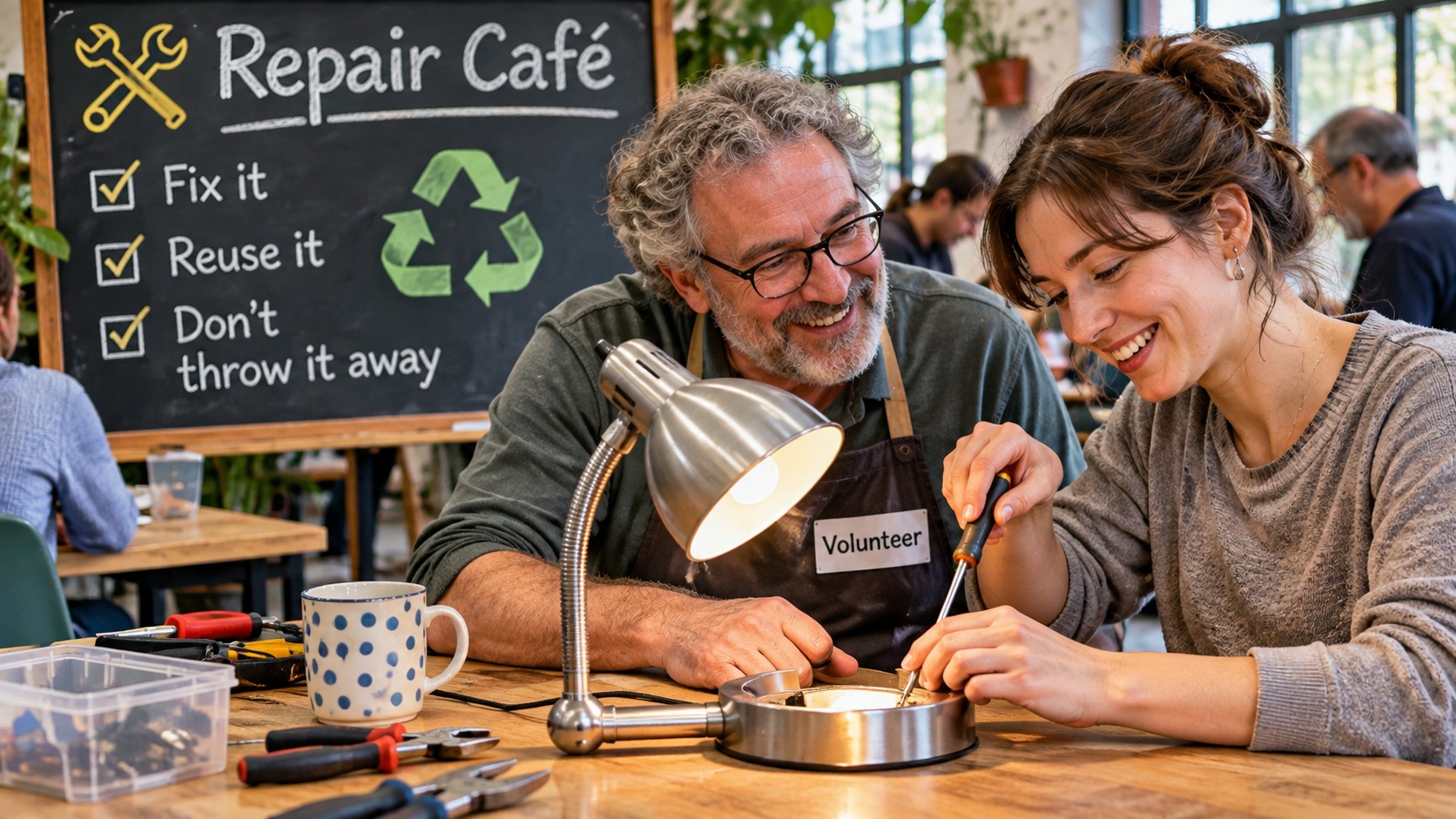
Could a broken lamp become a learning opportunity? Find out how repair cafés help people save money, reduce waste and share practical skills in their communities. Read the article below, then complete the nine-question reading quiz.
The Repair Café: Fix It, Don’t Throw It Away
On a Saturday morning, Emma was getting ready to throw away an old desk lamp. It had stopped working several weeks earlier, and she had already bought a new one. As she carried the lamp towards the rubbish bin, her neighbour suggested something different.
“Why don’t you take it to the repair café?” he asked.
Emma had never heard of a repair café before. Her neighbour explained that it was a place where people could bring broken objects and get help fixing them. The people who worked there were volunteers with different skills, and they enjoyed sharing their knowledge with others. Emma decided to give it a try.
When she arrived, she found a busy room with several tables. There were people repairing bicycles, sewing clothes, and working on small electrical objects. Tools covered the tables, and volunteers were talking to visitors about their problems. The atmosphere was friendly and relaxed. Nobody seemed worried about making mistakes.
Emma sat down with a volunteer called Peter, who had experience repairing electrical equipment. He looked at her lamp and asked a few questions about what had happened. After checking the cable and the switch, he discovered that a small part inside the lamp was damaged. Luckily, he had a replacement part in his toolbox. He showed Emma how to remove the broken part and fit the new one. A few minutes later, the lamp was working again.
Emma was surprised. She had expected someone to repair the lamp for her, but Peter had encouraged her to do it herself. He explained that this was an important part of the repair café idea. Visitors were not simply bringing their broken things to experts. They were also learning useful skills that they could use in the future.
Repair cafés offer several benefits. First, they can help people save money. Buying a new household item can be expensive, especially when the problem with the old one is quite small. Second, repairing objects is better for the environment. When people throw things away, they create more rubbish. New products also require materials, energy, and transport. By repairing something instead of replacing it, people can reduce the amount of waste they produce.
There is also a social benefit. Many repair cafés bring together people of different ages and backgrounds. Someone who knows how to repair a bicycle might help a person who has never used a set of tools before. Older visitors can share skills they learned many years ago, while younger visitors may bring new ideas. In this way, people learn from each other and become part of their local community.
However, repair cafés cannot solve every problem. Some objects are too badly damaged to repair, while others need special parts that are difficult to find. Electrical equipment can also be dangerous if people do not know how to work with it safely. For this reason, volunteers must understand their limits and sometimes advise visitors to take an item to a professional.
After her visit, Emma began to look at broken objects differently. In the past, she had usually replaced them without thinking twice. Now she wondered whether they could be repaired first. She even started keeping a small box of basic tools at home.
Repair cafés are not just places where people fix old objects. They encourage a different way of thinking. Instead of treating broken things as rubbish, people can see them as opportunities to learn, save money, and help the environment. And sometimes, all it takes to give an old object a second life is a little time, a few tools, and someone willing to share their knowledge.
Check your understanding
Answer the questions in the interactive exercise below. You can check your answers, read the feedback and try again.