
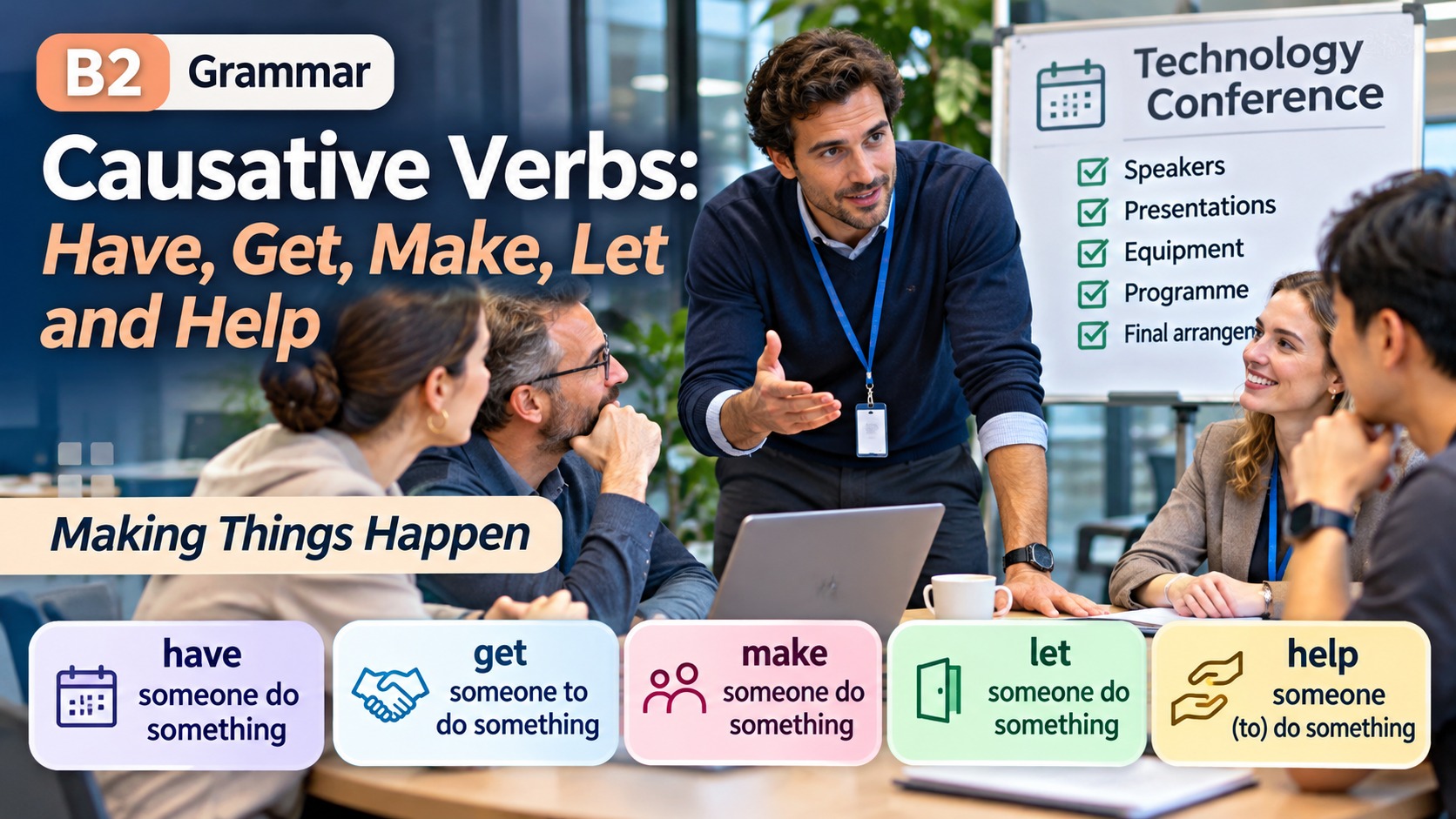
Discover the grammar: The Conference Challenge
Daniel had been given just three weeks to organize his company’s annual technology conference. More than 200 guests were expected, and his manager wanted everything to run perfectly.
At the first planning meeting, Daniel had his assistant contact the guest speakers and confirm their availability. He also got the marketing team to design a new promotional campaign, although they were initially reluctant because of their workload.
The biggest challenge was preparing the presentations. Some speakers hadn’t submitted their slides, so Daniel’s manager made everyone send their materials by Friday. Daniel thought the deadline was rather strict, but it helped the team stay on schedule.
Meanwhile, several employees wanted to contribute their own ideas. Daniel let them suggest changes to the conference programme, and one colleague proposed an interactive technology demonstration.
Daniel liked the idea, but the demonstration required expensive equipment. Fortunately, he got a local technology company to lend them the necessary devices. The company’s engineers also helped the organizers set up the equipment.
Two days before the conference, a speaker cancelled unexpectedly. Daniel had his assistant call several possible replacements, but nobody was available. Eventually, he got one of the company’s senior engineers to give the presentation instead.
On the morning of the event, Daniel’s manager made the entire team arrive an hour early to check the final arrangements. However, she let everyone take a longer lunch break once the opening session had finished.
The conference was a success. Daniel realized that good leadership wasn’t simply about telling people what to do. Sometimes you needed to persuade people, sometimes you needed to give them freedom, and sometimes you just needed to help them succeed.
Notice the grammar
- Daniel had his assistant contact the speakers. Who actually contacted them?
- Daniel got the marketing team to design a campaign. Why might get be more appropriate than have here?
- The manager made everyone send their materials. Was this optional?
- Daniel let them suggest changes. Did he require them to suggest anything?
- The engineers helped the organizers set up equipment. What was the engineers’ role?
- Which verbs take a base verb? Which takes to? Which allows either?
Try to answer before you read the rules.
Causative verb reference
| Verb | Pattern | Meaning | Example |
|---|---|---|---|
| Have | have + person + base verb | Arrange or instruct | Daniel had his assistant call the speakers. |
| Get | get + person + to + verb | Persuade or arrange | He got an engineer to give the talk. |
| Make | make + person + base verb | Require or force | The manager made everyone arrive early. |
| Let | let + person + base verb | Allow or permit | She let everyone take a break. |
| Help | help + person + (to) + verb | Assist or facilitate | The engineers helped us (to) set up. |
How the structures work
Have someone do something
Use have + person + base verb to arrange for or instruct someone to do something: The director had her assistant send the invitations. No to after have in this pattern.
Get someone to do something
Use get + person + to-infinitive when you persuade, encourage or manage to arrange for someone to act: We got the sponsor to cover the costs. Get can suggest effort, but it does not always mean persuasion.
Make someone do something
Use make + person + base verb for requiring or forcing: The rules made everyone wear a badge. In the passive, use be made + to-infinitive: Everyone was made to wear a badge.
Let someone do something
Use let + person + base verb to give permission: The organizer let the volunteers leave early. To express permission in the passive, use be allowed to: The volunteers were allowed to leave early.
Help someone (to) do something
Both patterns are correct: The guide helped us find the venue / The guide helped us to find the venue. Help can also be used without a person: Clear signs help (to) reduce confusion.
Compare the meaning
Made: The manager made Alex stay late (required him). Got: The manager got Alex to stay late (persuaded or arranged for him to). Had: The manager had Alex stay late (instructed him). Let: The manager let Alex stay late (permitted him to). Helped: The manager helped Alex (to) stay late (assisted him).
Negatives, questions and tense
Change the causative verb for tense or questions: Did she get the team to agree? / She didn’t let them leave. / We’ve had the technician check it. / They will help us (to) prepare. The second verb stays in the required form.
Common mistakes
- ✗ She made me
to wait. ✓ She made me wait. - ✗ They let us
to enter. ✓ They let us enter. - ✗ He got me
help. ✓ He got me to help. - ✗ The boss had her
to emaileveryone. ✓ The boss had her email everyone. - ✗ We were made
worklate. ✓ We were made to work late.
Next: Complete the 25-question interactive practice below. Check your answers to see explanations and model answers; then retry any questions you missed.