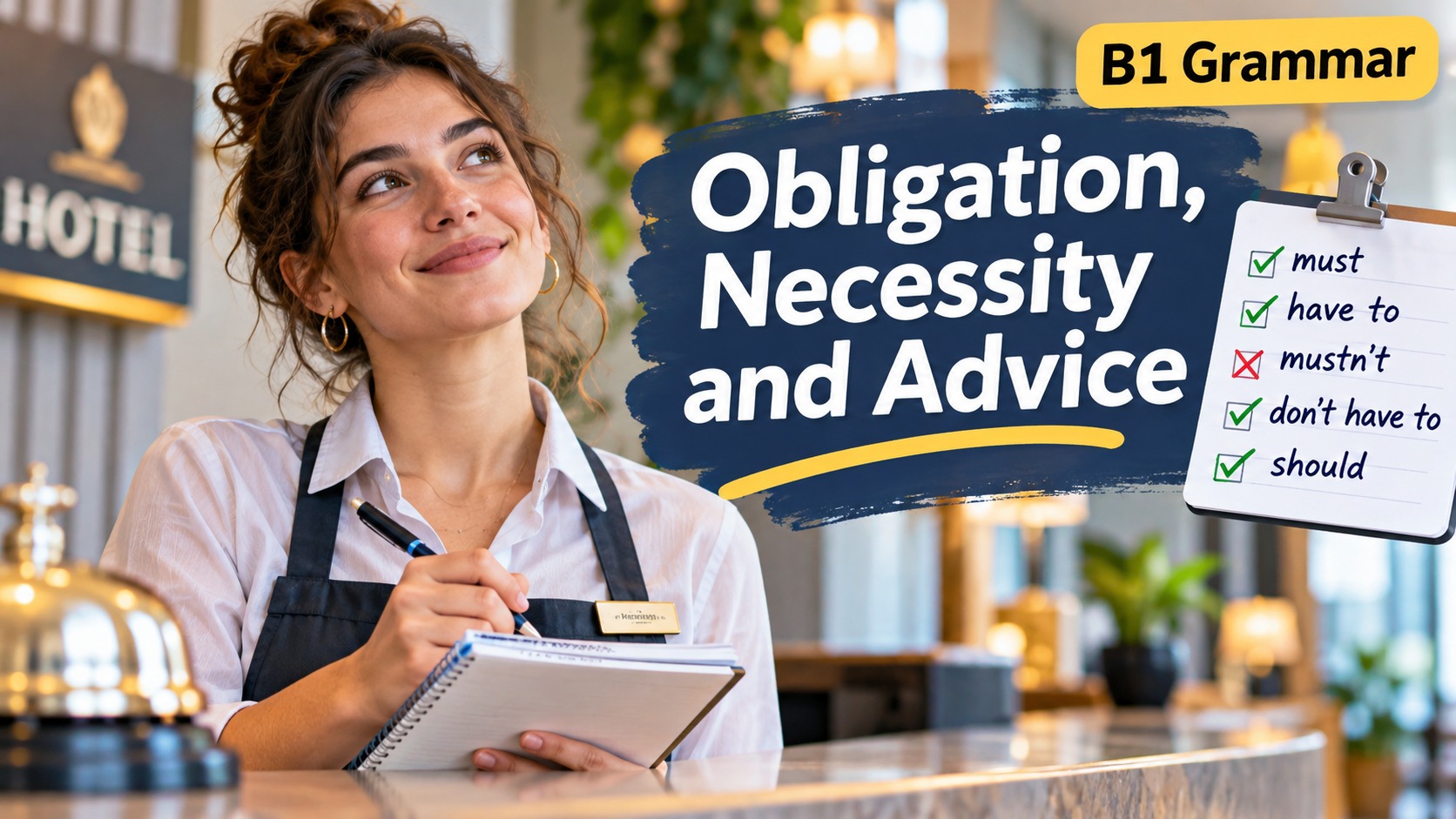
A New Job, New Rules
On Monday, Emma started a new job at a busy hotel. Before her first shift, her manager explained some important rules.
“All employees have to arrive at least fifteen minutes before their shift. You must wear your uniform, and you mustn’t use your phone while you’re working at reception. However, you don’t have to wear your uniform during your lunch break.”
Emma was a little nervous, so she asked her colleague Daniel for advice.
“You should write down the most important rules,” Daniel said. “And you shouldn’t worry too much. Everyone makes mistakes during their first week.”
Emma remembered her previous job. She had to work every weekend, but at the hotel she only worked one weekend a month. Next week, she will have to attend a training session about customer service.
By Friday, Emma felt much more confident. There were lots of rules, but she understood why they were important.
Notice the grammar
Read the highlighted expressions again. Before reading the explanations, think about these questions:
- Which expressions describe something compulsory?
- Which expression means something is forbidden?
- Which expression means something is optional?
- Which expressions give advice?
- How does Emma talk about past and future obligations?
Grammar reference
1. Obligation and necessity: must and have to
Form: subject + must / have to + base verb. With he/she/it, use has to.
Staff must wear an ID badge. / Emma has to arrive early.
Both express obligation. Have to is especially common for rules and circumstances outside our control; must often expresses a strong personal instruction or the speaker’s view. In many situations, both are possible.
Questions: Do you have to work weekends? For ordinary questions about obligations, have to is more natural than must.
2. Prohibition: mustn’t
Form: subject + mustn’t + base verb.
You mustn’t share your password. This means the action is prohibited, not simply unnecessary.
3. No obligation: don’t have to
Form: subject + don’t / doesn’t have to + base verb.
You don’t have to wear a tie. You can wear one, but it isn’t required.
Important: You mustn’t leave = leaving is forbidden. You don’t have to leave = leaving is optional. These do not mean the same thing.
4. Advice: should and shouldn’t
Form: subject + should / shouldn’t + base verb. The form stays the same for all subjects.
You should ask for help. / You shouldn’t skip breakfast. These express advice or opinions, not strict rules. Ought to is a less common alternative to should.
5. Past and future obligations
Past: had to + base verb — She had to work last Saturday. For past absence of obligation, use didn’t have to.
Future: will have to + base verb — We will have to finish the training next week. Must has no separate past-tense form; have to changes tense.
Quick reference
| Meaning | Structure | Example |
|---|---|---|
| Obligation | must / have to | You must sign in. |
| Prohibition | mustn’t | You mustn’t park here. |
| No obligation | don’t have to | You don’t have to pay. |
| Advice | should / shouldn’t | You should rest. |
| Past obligation | had to | We had to wait. |
| Future obligation | will have to | I’ll have to call. |
Ready to practise? Complete the four activities below. Check your answers to see explanations, then try again if you want to improve your score.