
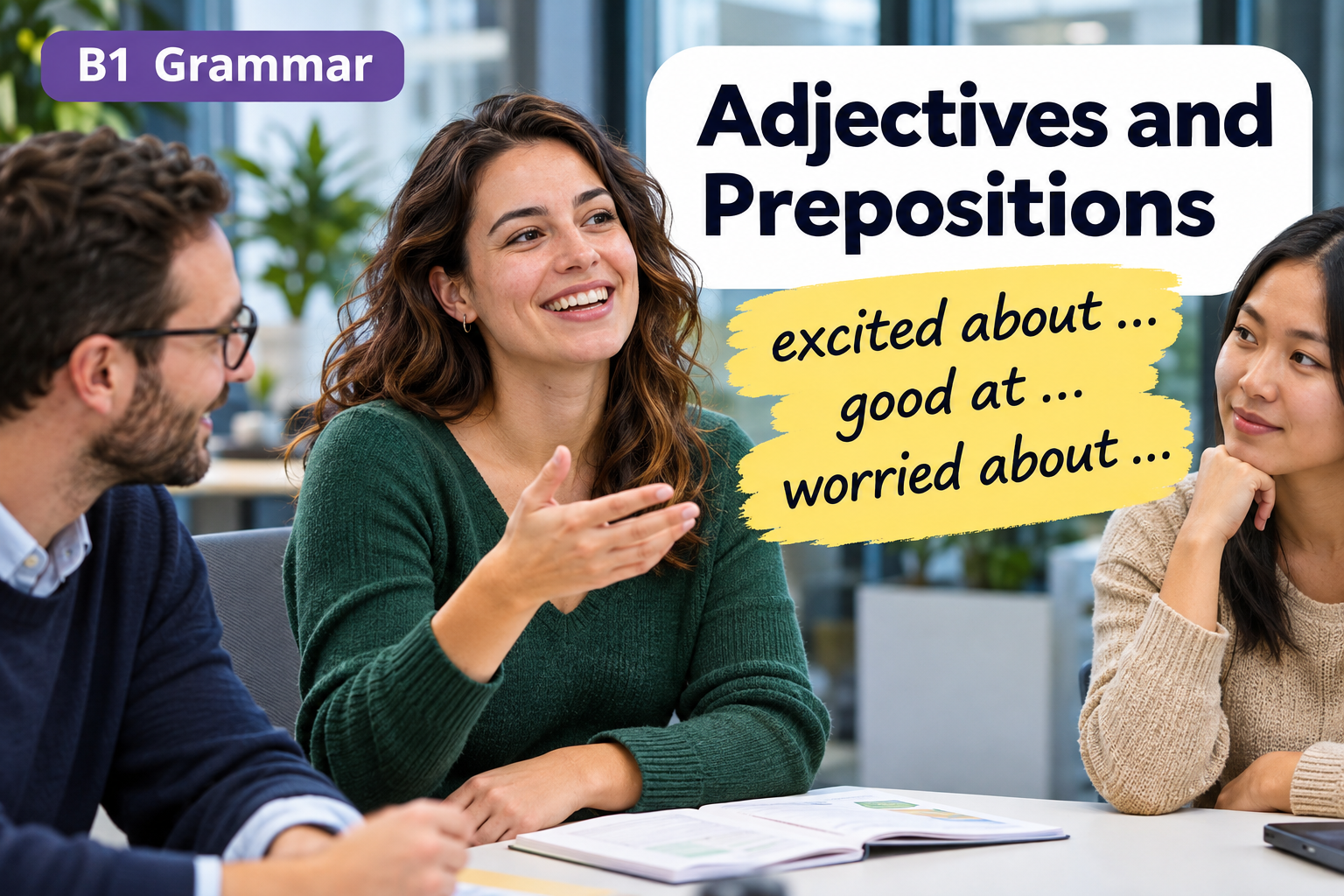
Read the story A New Beginning and notice how adjectives are followed by prepositions. Complete the discovery activities before reviewing the patterns and starting the interactive practice.
A New Beginning
When Sarah started her new job at a large international company, she was excited about the opportunity. She had always been interested in business, and she was particularly keen on working with an international team.
Her new office was very different from her previous workplace. The company was famous for its excellent training programs, and Sarah was pleased with the welcome she received from her colleagues. She quickly became close to several people in her department.
Sarah was good at organizing meetings and solving problems, so her manager was proud of her progress. She was also kind to everyone, even when people were having a difficult day.
However, after a few months, Sarah began to feel tired of working late. She was fed up with the long meetings that often had no clear purpose. She was also worried about the amount of work her team had to do.
One afternoon, a colleague was rude to Sarah during a meeting. Sarah was angry with him, but she was more upset about the way he spoke to the other members of the team.
That evening, Sarah talked to her husband, who was very fond of her and always listened carefully. He reminded her that she was good at her job and that she shouldn’t forget how much she had achieved.
Discover the patterns
- Find eight adjective + preposition combinations in the story.
- Which preposition follows excited? Which follows interested?
- Find adjectives followed by of.
- Which adjective is followed by with when Sarah describes the meetings?
- Find two examples of angry or similar feelings followed by different prepositions. What is each preposition referring to?
- Look at the words after the prepositions. What form are the verbs in?
1. The pattern
Many adjectives are followed by a particular preposition. The combination is often best learned as a chunk of language.
afraid of · interested in · famous for · good at · pleased with · worried about
There isn’t always a simple rule that tells you which preposition to use. Learn the adjective and its preposition together.
2. Adjectives followed by different prepositions
Some adjectives can take more than one preposition. The preposition depends on what you mean.
- angry with someone: I’m angry with my colleague.
- angry about something: I’m angry about the decision.
- good at a skill/activity: She’s good at organizing.
- good for someone/something: Exercise is good for you.
3. Prepositions followed by -ing
When a verb comes after a preposition, it normally takes the -ing form.
excited about starting · interested in learning · tired of waiting · good at solving
Remember: the preposition is followed by a noun, pronoun, or gerund (-ing form), not an infinitive.
Now let’s practise these combinations.