
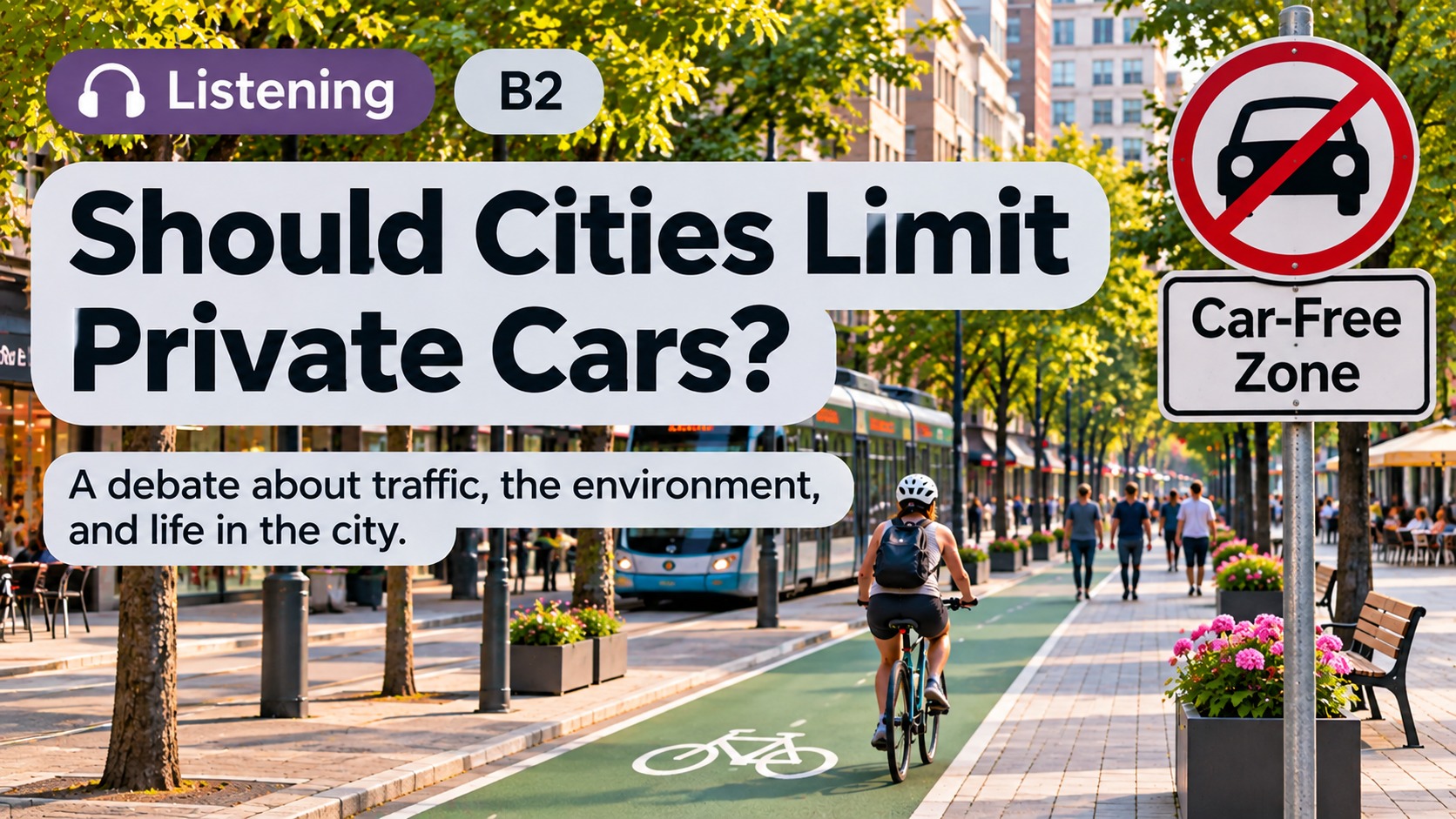
Listen to a radio discussion about whether cities should limit private car use. Daniel supports stronger restrictions, while Sophie questions whether they are always fair or practical. Before listening, think about the advantages and disadvantages of reducing cars in city centres.
Listen to the discussion and complete the ten activities. You can replay the audio before checking your answers.
Read the transcript
Transcript
[Emma – Presenter]
Welcome to The City Debate, where we look at some of the issues shaping the way we live. Today, we're discussing a question that has become increasingly important in major cities around the world: should governments limit the use of private cars in city centres? Some cities have introduced congestion charges, pedestrian-only areas, or restrictions on older vehicles. Supporters say these measures are necessary to improve air quality and reduce traffic. Others argue that they unfairly restrict people's freedom. Joining me today are Daniel, who supports stronger restrictions, and Sophie, who believes cities need to be more careful. Daniel, let's start with you. Why do you think private cars have become such a problem?
[Daniel]
Well, I think we've reached a point where the number of cars in many cities is simply unsustainable. Think about how much space we give to vehicles. We have enormous roads, parking areas, and traffic systems, yet people still spend hours sitting in traffic every week. And it's not just frustrating. It affects people's health. Air pollution is a serious issue, particularly for children and older people. If we reduce the number of cars, we could make streets safer, quieter, and more pleasant places to live.
[Sophie]
I agree that traffic and pollution are serious problems, but I don't think restricting cars is necessarily the best solution. We have to bear in mind that not everyone has the same circumstances. Someone who lives in the city centre and works near a metro station has plenty of options. But what about someone who lives in a small town outside the city and has to drive to work? Or a parent who needs to take two children to different schools before starting work? For those people, a car isn't just a convenient way to travel. It's essential.
[Emma – Presenter]
That's an important point. Daniel, how would you respond to people who say they simply don't have a realistic alternative to driving?
[Daniel]
I wouldn't expect cities to ban cars immediately. That would be completely unrealistic. But I think restrictions can be introduced gradually, alongside improvements to public transport. For example, cities could make buses more frequent, extend metro lines, and create safer cycling routes. If public transport is reliable and affordable, more people will be willing to use it. At the moment, many people drive because it's the easiest option, not necessarily because they enjoy driving.
[Sophie]
But that's where I think the problem is. Governments sometimes introduce restrictions first and promise to improve public transport later. People are then left dealing with the consequences. I've seen cities where parking has become more expensive and certain roads have been closed, but the bus services haven't improved at all. If you want people to change their habits, you have to give them a practical alternative. Otherwise, you're just making everyday life more difficult.
[Emma – Presenter]
Let's talk about congestion charges. Some cities charge drivers a fee to enter busy areas. Supporters say this discourages unnecessary journeys and raises money for transport improvements. Sophie, do you think that's a fair approach?
[Sophie]
It depends on how the system works. If the fee is the same for everyone, it could have a much greater impact on people with lower incomes. A wealthy person might not think twice about paying it, while someone earning an average salary might find it expensive. I also think we need to consider people who have disabilities or work unusual hours when public transport isn't available. A policy might sound fair in theory, but it doesn't always work fairly in practice.
[Daniel]
I agree that there should be exceptions for certain groups. However, I don't think the possibility of unfairness means we should avoid the policy altogether. We could offer discounts or exemptions to people who genuinely need to drive. And the money collected could be invested in cheaper public transport. We shouldn't forget that traffic congestion also costs people money. They waste fuel, lose time, and sometimes arrive late for work. There are costs to doing nothing, too.
[Emma – Presenter]
So perhaps the real question isn't whether cities should restrict cars, but how they should do it. Would you both agree that some areas should be made completely car-free?
[Daniel]
Absolutely. I think pedestrian areas can make a huge difference. When people aren't constantly worried about traffic, they're more likely to walk around, visit local shops, and spend time outside. Some businesses initially worry that fewer cars will mean fewer customers. But in pedestrian-friendly areas, people may actually stay longer and visit more often. It's not always easy to predict the results.
[Sophie]
I wouldn't oppose pedestrian areas in every situation. In fact, I think they're a good idea in historic centres or streets with lots of shops and restaurants. But we shouldn't assume that one solution works everywhere. A city with an excellent transport network can introduce more restrictions than a city where buses are unreliable and neighbourhoods are spread out. Local conditions really matter.
[Emma – Presenter]
It sounds as though you're closer in your opinions than we first thought. Daniel wants cities to reduce car use, while Sophie wants to make sure people aren't disadvantaged in the process. If you could each recommend one practical change, what would it be?
[Daniel]
I'd start by improving public transport and making it more affordable. Then I'd gradually reduce parking in the busiest areas and use that space for wider pavements, trees, and cycle lanes. The important thing is to give people better choices, rather than simply telling them what they can't do.
[Sophie]
I'd also improve public transport, but I'd make sure that people living outside city centres are included in the planning. I'd introduce restrictions only when there are realistic alternatives, and I'd regularly ask residents whether the changes are working. People are more likely to support a policy if they feel they've been listened to.
[Emma – Presenter]
Some interesting points there. It seems that reducing private car use may be part of the solution, but successful policies need to consider the different needs of the people who live and work in each city. Thank you both for joining us today.